Bali as a Stage
Expat Life, Reinvention and the Comedy of Paradise
Bali is often described as a destination, but in the Visa Run Orchestra universe it behaves more like a stage. People arrive with luggage, of course, but also with stories, wounds, ambitions, reinventions, spiritual vocabulary, business ideas, romantic expectations and the discreet hope that life might become more beautiful if placed under a better sky. The island is real, complex, sacred, inhabited, generous and far older than the fantasies projected onto it. But for many foreigners who pass through or settle here, Bali also becomes a theatre of becoming: a place where one can try on another version of oneself and see whether the costume holds.
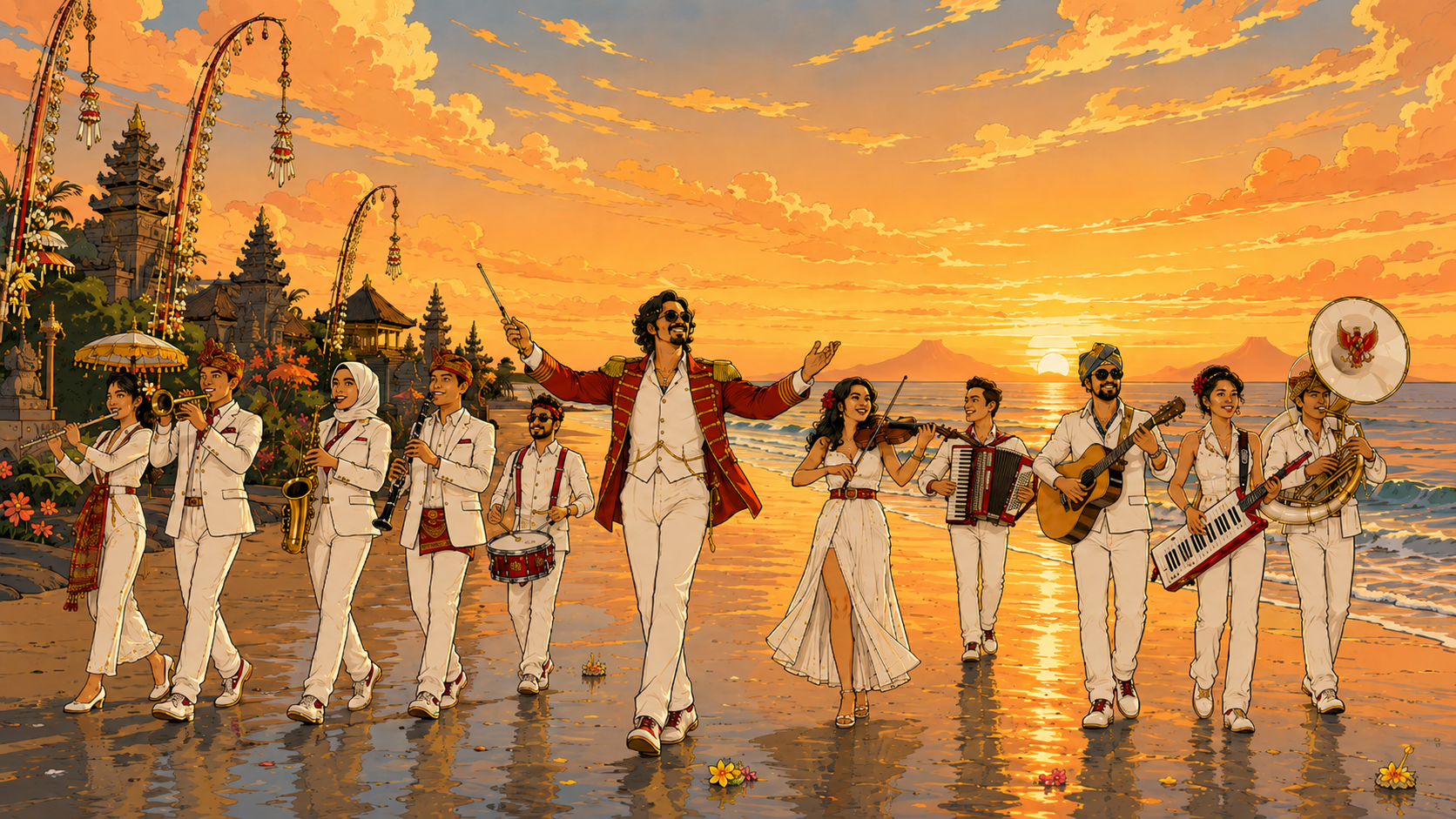
That is what makes Bali so powerful as a setting for narrative songs. It does not simply decorate the story; it reveals the characters. The digital nomad is not only working from a café. The wellness believer is not only drinking something green at sunrise. The romantic runaway is not only falling in love near the ocean. The investor, the yoga teacher, the healer, the influencer, the padel king, the charming disaster and the self-declared free spirit are all performing some version of freedom, success, healing or escape. Some of it is ridiculous. Some of it is sincere. Often, the comedy comes from the fact that both things are true at the same time.
This is the territory where Bali Bule Society first opened the door for Visa Run Orchestra. The song introduced Bali’s foreign tribe not as a sociological report, but as the chorus of an imaginary musical: funny, seductive, vain, vulnerable, opportunistic, wounded, elegant, lost, and occasionally very convinced that the universe has personally curated their smoothie bowl. From there, other songs began to reveal different corners of the same stage. Padel Is Life turned sport into social mythology. My Healthy Sunrise turned the morning routine into a small comedy of self-improvement. Red Flag brought desire and bad judgement into the room. Until It’s Reel (coming soon) looks at the moment when paradise becomes content and experience starts waiting for the camera before it feels complete.











The point is not to mock Bali, and it is not even only to mock the people who come here. That would be too easy, and not very interesting. The point is to observe what happens when beauty, freedom and distance from one’s previous life create a temporary permission to change. Bali makes certain illusions visible because it gives them such a beautiful background. It can make sincerity look theatrical and performance look almost spiritual. It can make people kinder, softer and more open; it can also make them more absurd, more entitled, more lost in the mythology they are trying to sell to others. Like any good stage, it does not create every drama, but it knows exactly how to light it.
This is why Bali matters so deeply to the Visa Run Orchestra universe. It is not just where the project began. It is the place that gave the songs their tension: paradise and paperwork, beauty and money, freedom and performance, tenderness and vanity, reinvention and self-deception. The island holds a strange mirror to everyone who arrives believing they are starting again. Some people become freer. Some become more exposed. Some discover that changing scenery is not the same as changing character. And some, fortunately for musical purposes, do all of this loudly enough to become a song.


In that sense, Bali as a stage is not only a metaphor. It is the central dramatic engine of the project. Visa Run Orchestra listens to the island’s theatre without pretending to own it. The songs move through foreign rituals, social performances, romantic warnings, wellness comedy, digital vanity and moments of genuine beauty, always aware that the real Bali is larger than any projection placed upon it. The stage is beautiful, but it is not empty. The comedy is human, but the island is not a joke. Somewhere between the two, the music begins.